

on this page
Mulch Your Interiors!
- Shop Now
If you've ever walked into a garden center looking for something to top off an indoor planter, you've probably seen bark chips on the shelf. They're everywhere, they're cheap, and they look like they might do the job.
They won't—at least not indoors.
Interior mulch and bark chips might look similar at a glance, but they are fundamentally different products built for fundamentally different environments. This post breaks down exactly what separates them, why it matters for your plants, and why anyone serious about indoor plantscaping—whether you're a professional installer or a home enthusiast—should know the difference before they buy.
What are bark chips?
Bark chips are a byproduct of the lumber industry. They're made by shredding or chipping the outer bark of trees—typically pine, cedar, or fir—and are sold primarily as an outdoor landscaping material.
Their job outdoors is practical: suppress weeds, retain soil moisture, and slowly decompose into the ground over time.
That last part—slowly decompose—is the key phrase. Outdoors, decomposition is a feature. It feeds the soil, improves structure, and gets replaced season to season. It's a system designed for open ground, rain, drainage, and seasonal cycles.
Take that same product indoors and the system breaks down entirely.
What is
interior mulch?
Interior mulch is a topdressing engineered for enclosed, indoor environments—planters in homes, hotels, offices, retail spaces, and commercial installations.
Our interior mulch is made from hardwood that has been toasted all the way through—naturally dried and colored by heat, not dyed with artificial pigments like most decorative mulches you'll find at a big box store. That toasting process does something bark chips simply can't offer indoors: it stabilizes the product.
Here's what that means in practice:
- Pasteurized — heat-treated to eliminate insect eggs, disease organisms, and mold spores before it ever goes into a planter.
-Highly durable — resists the decay and decomposition that makes bark chips a liability indoors.
- Stable color and texture — holds its appearance over time without fading, crumbling, or turning gray.
- Non-toxic and all natural — safe for the plants, safe for the people around them.
- Does not tie up plant nutrients — unlike decomposing bark, it won't compete with your plants for nitrogen or other essentials.
Why Bark Chips
Fail Indoors
Let's be specific about what goes wrong when you use an outdoor product in an indoor planter.
Decomposition becomes a problem, not a feature
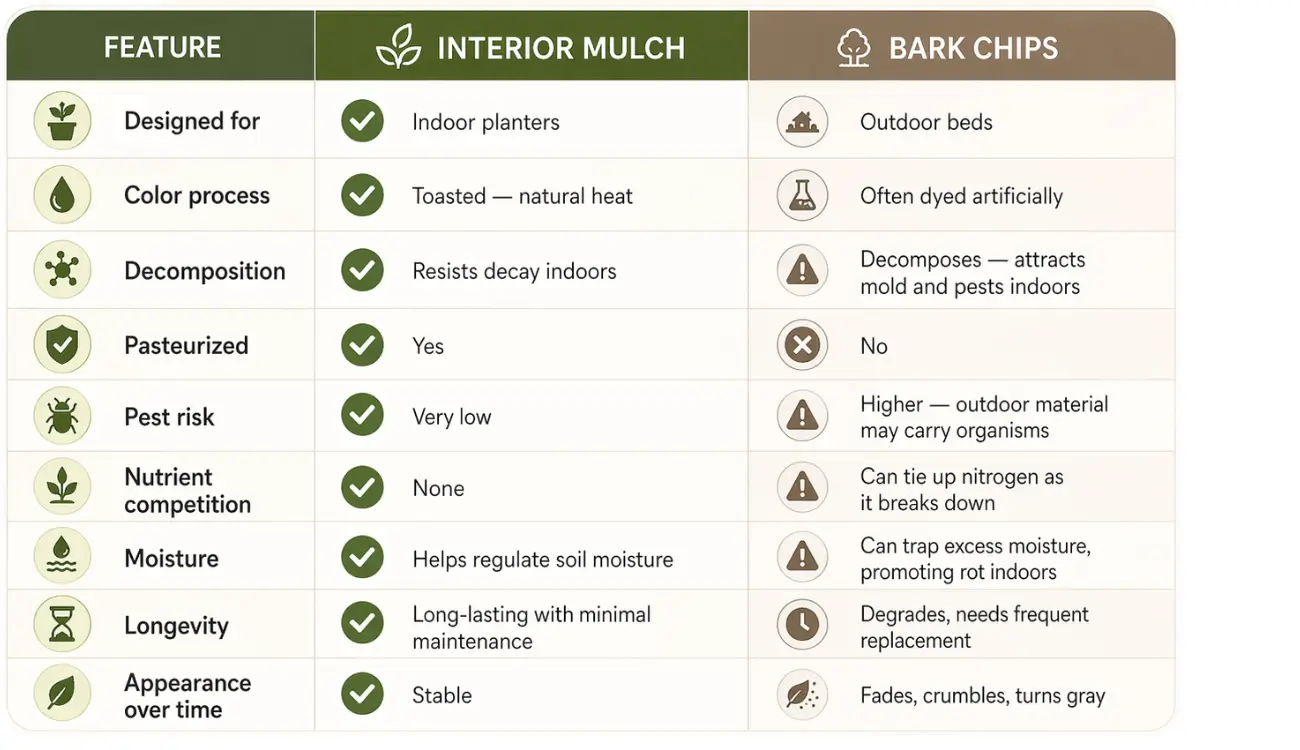
Indoors, there's no soil ecosystem to absorb the breakdown. Decomposing bark chips in a closed planter create the perfect conditions for mold, fungus gnats, and root rot. What works in a garden bed becomes a liability in a lobby planter.
Moisture trapping
Bark chips are designed to hold onto water—great for outdoor beds that dry out between rain events. In an indoor planter with no drainage to the ground, excess moisture retention can suffocate roots and create anaerobic conditions in the soil.
Pest introduction
Outdoor bark is outdoor material. It hasn't been pasteurized or heat-treated. Fungus gnat larvae, mite eggs, and other organisms that live harmlessly in garden soil become a real problem when introduced into a controlled indoor environment—especially in commercial spaces like hotels or corporate lobbies.
Appearance degrades fast
Bark chips gray out, crumble, and lose their form indoors within months. For a commercial installer, that means callbacks and unhappy clients. For a home plant enthusiast, it means your carefully styled planter looks neglected six months after you set it up.
Does It Actually Look Different?
Yes—significantly. Bark chips have an irregular, rough, outdoor texture. Interior mulch has a refined, consistent finish that reads as a deliberate design choice. In a commercial planter in a hotel lobby or an office atrium, that difference is immediately visible.
Interior mulch is the product that makes a planter look finished. Bark chips make it look like someone grabbed whatever was available.
For professional plantscapers, this matters enormously. The mulch topdressing is the last thing a client sees when you walk them through a completed install. It either confirms the quality of your work or undermines it.
Final Thoughts
Bark chips are a good product—for the right environment. Outdoors, in a garden bed, they do exactly what they're supposed to do.
Indoors, they're the wrong tool for the job. They decompose, they trap moisture, they introduce pests, and they look rough in finished spaces.
Interior mulch is purpose-built for the indoor environment. It's stabilized, pasteurized, durable, and designed to look great in the planters where it lives—whether that's a statement floor planter in a museum atrium or a ceramic pot on a home windowsill.
If you're finishing indoor planters and you're still reaching for bark chips out of habit, this is your sign to make the switch.
Working on a
commercial install?
Our team can help with bulk quantities, spec support, and sample packs for client presentations.
FAQ
Q: Can I use bark chips in indoor planters if I can't find interior mulch?
We'd recommend against it. The decomposition and pest risk alone make bark chips a poor choice for enclosed indoor environments. Interior mulch is specifically designed to avoid those problems.
Q: Is interior mulch the same as decorative wood chips?
Not quite. Most decorative wood chips are dyed with artificial colorants and aren't pasteurized. Interior mulch is toasted—the color comes from the heat process itself—and is heat-treated to eliminate organisms before use.
Q: How long does interior mulch last compared to bark chips indoors?
Interior mulch is significantly more durable in indoor conditions. Because it resists decomposition, it holds its color and texture far longer than bark chips, which begin to degrade and gray out within months in a closed planter environment.
Q: Does interior mulch smell?
Interior mulch has a mild, natural wood scent when first opened that fades quickly. Bark chips, especially when they begin to decompose in a moist indoor environment, can develop an unpleasant odor over time.
by Brandon Haas
Published on April 22, 2026
Unsubscribe anytime. By entering your email, you agree to receive marketing emails from Interior Mulch Scapes. By proceeding, you agree to the Terms and Conditions and Privacy Policy.
popular posts
INTERIOR MULCH
Should You Mulch Indoor Plants?
TIPS
How Deep Should Mulch Be?
INTERIOR MULCH
4 Tips to Begin Interior Landscaping
INTERIOR MULCH
What is Interiorscaping?
on this page
Mulch Your Interiors!
- Shop Now
If you've ever walked into a garden center looking for something to top off an indoor planter, you've probably seen bark chips on the shelf. They're everywhere, they're cheap, and they look like they might do the job.
They won't—at least not indoors.
Interior mulch and bark chips might look similar at a glance, but they are fundamentally different products built for fundamentally different environments. This post breaks down exactly what separates them, why it matters for your plants, and why anyone serious about indoor plantscaping—whether you're a professional installer or a home enthusiast—should know the difference before they buy.
What are bark chips?
Bark chips are a byproduct of the lumber industry. They're made by shredding or chipping the outer bark of trees—typically pine, cedar, or fir—and are sold primarily as an outdoor landscaping material.
Their job outdoors is practical: suppress weeds, retain soil moisture, and slowly decompose into the ground over time.
That last part—slowly decompose—is the key phrase. Outdoors, decomposition is a feature. It feeds the soil, improves structure, and gets replaced season to season. It's a system designed for open ground, rain, drainage, and seasonal cycles.
Take that same product indoors and the system breaks down entirely.
What is
interior mulch?
Interior mulch is a topdressing engineered for enclosed, indoor environments—planters in homes, hotels, offices, retail spaces, and commercial installations.
Our interior mulch is made from hardwood that has been toasted all the way through—naturally dried and colored by heat, not dyed with artificial pigments like most decorative mulches you'll find at a big box store. That toasting process does something bark chips simply can't offer indoors: it stabilizes the product.
Here's what that means in practice:
- Pasteurized — heat-treated to eliminate insect eggs, disease organisms, and mold spores before it ever goes into a planter.
-Highly durable — resists the decay and decomposition that makes bark chips a liability indoors.
- Stable color and texture — holds its appearance over time without fading, crumbling, or turning gray.
- Non-toxic and all natural — safe for the plants, safe for the people around them.
- Does not tie up plant nutrients — unlike decomposing bark, it won't compete with your plants for nitrogen or other essentials.
Why Bark Chips
Fail Indoors
Let's be specific about what goes wrong when you use an outdoor product in an indoor planter.
Decomposition becomes a problem, not a feature
Indoors, there's no soil ecosystem to absorb the breakdown. Decomposing bark chips in a closed planter create the perfect conditions for mold, fungus gnats, and root rot. What works in a garden bed becomes a liability in a lobby planter.
Moisture trapping
Bark chips are designed to hold onto water—great for outdoor beds that dry out between rain events. In an indoor planter with no drainage to the ground, excess moisture retention can suffocate roots and create anaerobic conditions in the soil.
Pest introduction
Outdoor bark is outdoor material. It hasn't been pasteurized or heat-treated. Fungus gnat larvae, mite eggs, and other organisms that live harmlessly in garden soil become a real problem when introduced into a controlled indoor environment—especially in commercial spaces like hotels or corporate lobbies.
Appearance degrades fast
Bark chips gray out, crumble, and lose their form indoors within months. For a commercial installer, that means callbacks and unhappy clients. For a home plant enthusiast, it means your carefully styled planter looks neglected six months after you set it up.
Does It Actually Look Different?
Yes—significantly. Bark chips have an irregular, rough, outdoor texture. Interior mulch has a refined, consistent finish that reads as a deliberate design choice. In a commercial planter in a hotel lobby or an office atrium, that difference is immediately visible.
Interior mulch is the product that makes a planter look finished. Bark chips make it look like someone grabbed whatever was available.
For professional plantscapers, this matters enormously. The mulch topdressing is the last thing a client sees when you walk them through a completed install. It either confirms the quality of your work or undermines it.
Final Thoughts
Bark chips are a good product—for the right environment. Outdoors, in a garden bed, they do exactly what they're supposed to do.
Indoors, they're the wrong tool for the job. They decompose, they trap moisture, they introduce pests, and they look rough in finished spaces.
Interior mulch is purpose-built for the indoor environment. It's stabilized, pasteurized, durable, and designed to look great in the planters where it lives—whether that's a statement floor planter in a museum atrium or a ceramic pot on a home windowsill.
If you're finishing indoor planters and you're still reaching for bark chips out of habit, this is your sign to make the switch.
Working on a
commercial install?
Our team can help with bulk quantities, spec support, and sample packs for client presentations.
FAQ
Q: Can I use bark chips in indoor planters if I can't find interior mulch?
We'd recommend against it. The decomposition and pest risk alone make bark chips a poor choice for enclosed indoor environments. Interior mulch is specifically designed to avoid those problems.
Q: Is interior mulch the same as decorative wood chips?
Not quite. Most decorative wood chips are dyed with artificial colorants and aren't pasteurized. Interior mulch is toasted—the color comes from the heat process itself—and is heat-treated to eliminate organisms before use.
Q: How long does interior mulch last compared to bark chips indoors?
Interior mulch is significantly more durable in indoor conditions. Because it resists decomposition, it holds its color and texture far longer than bark chips, which begin to degrade and gray out within months in a closed planter environment.
Q: Does interior mulch smell?
Interior mulch has a mild, natural wood scent when first opened that fades quickly. Bark chips, especially when they begin to decompose in a moist indoor environment, can develop an unpleasant odor over time.